Georgia Recorded Statement to Insurance After Accident
November 16, 2026
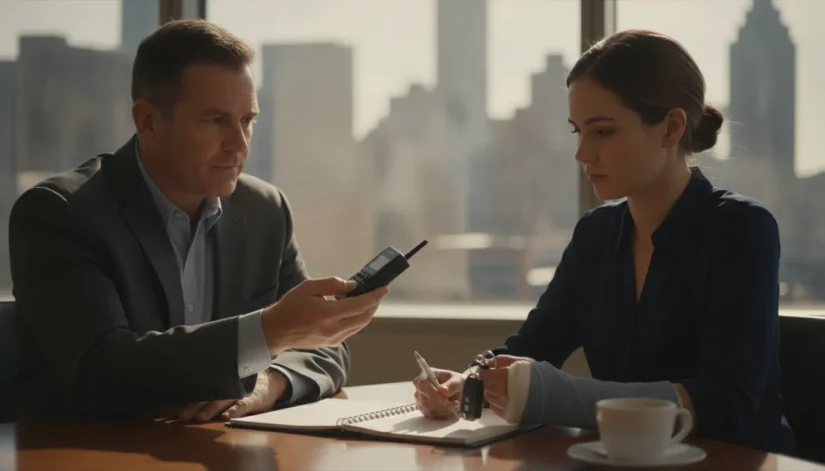
A Georgia recorded statement to insurance after accident calls can arrive before you have the police report. The adjuster wants a saved interview about speed, the light, and your injuries. You can give basic claim facts and still wait before you narrate the crash on a recording.
Call (404) 835-4935 to request a free consultation with Henningsen Injury Attorneys before you agree to a recording. The firm represents people hurt in car, truck, motorcycle, bicycle, pedestrian, rideshare, and bus crashes across Georgia, including Macon car accident claims.
What a Georgia recorded statement to insurance after accident means
A recorded statement is a phone or in-person interview that the insurer saves. The adjuster asks how the crash happened, where you were going, whether you were hurt, and what treatment you have had. The recording can be typed into a transcript. Later it is compared with the police report, photos, and medical records.
That interview is different from the basic facts Georgia’s Office of the Commissioner of Insurance says to exchange after a crash. The state’s auto claim tips tell drivers to collect names, phone numbers, plate numbers, insurance information, and witness contacts. They also say to notify your own insurer promptly, even if someone else caused the crash.
Those same tips say not to make oral or written statements about responsibility or blame. They also say not to discuss the specifics of the crash with the other drivers, passengers, or witnesses. A short report of who, where, and when is not a recorded interview about fault.
People mix the two because the call comes quickly. It often arrives while they are still sore, arranging a tow, or waiting on a ride home. You can give the claim number, the date, and the location without walking through every lane change on tape.
Ask the caller to spell the company name and to say whether a recording is already running. If it is, you can say you will call back after you have the claim number written down. That pause is ordinary. It is not a refusal to report the crash.
Whose adjuster is asking for the recording?
The careful answer depends on which company placed the call. The two common callers are the other driver’s insurer and your own insurer. They do not stand in the same place, and a script that fits one can be a poor fit for the other.
The other driver’s insurance company
The other driver’s insurer is evaluating a claim against its own customer. It is not your advisor. There is no general Georgia rule that forces an injured person to sit for that company’s recorded interview. You can ask for the request in writing. You can also say you are getting medical care and decline the recording until you understand the claim.
Adjusters often call within a day or two. They may say the recording will speed the file up, or that they cannot move it without your voice on tape. Speed is not the same as a complete picture of your injuries. Treatment, work limits, and vehicle damage often become clearer after the first week, not during the first phone call.
You can still be useful to the claim without a monologue. Share your name, the date, the location, the vehicles, and where the report can be requested. Leave speed, the signal color, and injury details for a time when you are looking at notes instead of guessing from memory.
Your own insurance company
Your own policy is a contract. Many auto policies ask the insured person to cooperate with an investigation and to report the crash promptly. Georgia’s motor-vehicle insurance law also requires liability policies for vehicles principally garaged or used in this state to include a cooperation provision, O.C.G.A. § 33-7-15. The insured must send the insurer copies of lawsuit papers and cooperate in the defense of a covered action. If a failure to cooperate prejudices the insurer, that statute can relieve the insurer of its duty to defend and to pay a judgment for its insured.
That rule is about helping your insurer defend a claim against you. It is not a statewide order that every injured person must record a statement for the other driver’s company. Court decisions have also treated it as distinct from simple notice that a crash occurred. Policy language on notice and cooperation still matters, and it lives in your contract, not in a phone script.
If your own insurer asks for a statement, read the notice and ask what the recording is for. It might be collision repair, medical payments coverage, an uninsured motorist claim, or a defense if someone is blaming you. Those are different conversations. A Georgia car accident claim can involve more than one of them at the same time.
Reporting the loss is still the right early step. The Commissioner of Insurance tells drivers to call their own company or agent as soon as possible. Including when they are far from home and when another person caused the crash. Ask which forms support the claim. Ask whether a recorded interview is required for the coverage you are actually using.
How a recorded statement can affect a car accident claim
Georgia generally requires the injured person to show that another driver was negligent and that the negligence caused the harm. Georgia is not a no-fault state for ordinary auto injury claims. Words captured early can be set next to photos, the crash report, and medical notes months later.
The trouble spots are usually ordinary sentences, not dramatic admissions:
- “I’m fine,” or “it’s just soreness,” said before a doctor has examined you.
- A guess about speed, the light, or how many car lengths you were following.
- A partial medical history that leaves out a prior condition the records will show.
- An apology or a comment about fault, which the state claim tips warn against.
Insurers also look at whether you sought treatment and how the bills are being handled. That question is separate from the recording. Our guide to who pays medical bills after a car accident in Georgia covers health insurance, medical payments coverage, and liens. A recorded interview is a poor place to sort those bills out.
A recording is also a weak substitute for the documents the Commissioner of Insurance already points to. Get the officer’s name and badge number. Ask when the report will be available and how to obtain a copy. Note the vehicles, the setting, the weather, the signals, and the road. Take photographs if you can. Draw a simple diagram of where the vehicles met. Those items are easier to correct than a transcript.
If the other driver had no insurance, the next question is often an uninsured motorist claim under your own policy. That process is explained in how much an uninsured motorist claim can involve. It is a different conversation from a recorded statement for the at-fault driver’s company. It still depends on the policy language and the proof of the crash.
Older firm writing on what an insurance company may say after an accident covers common adjuster lines in general. This article stays on one decision: whether to give a saved interview, and to whom.
What to do before you agree to a recorded statement
You can be polite and still slow the conversation down. A practical order looks like this.
- Write down the caller’s name, company, phone number, and claim number. Ask whether they insure you or the other driver.
- Get medical care and follow the treatment plan. Henningsen looks at crashes that were not the injured person’s fault, that need medical treatment, and that happened within the last two years.
- Keep the police report number, photos, and the other driver’s insurance card. Do not debate blame at the scene or in a group text with witnesses.
- Notify your own insurer of the crash, even when you believe the other driver caused it. Ask what the policy requires and which forms support the claim.
- If the other insurer wants a recording, ask for the questions in writing. Limit the call to name, date, location, and vehicles until you have advice.
- If your own insurer wants a recording, ask which coverage the questions concern before you start. Take the call when you can look at your notes.
Henningsen Injury Attorneys, P.C. handles insurer contact as part of representation in motor-vehicle cases. Todd Henningsen is the managing partner. People reach the firm through a 24/7 answering service, and direct calls are the contact path the firm prefers. Published offices are a Sandy Springs mailing address, a Cumming office, and a McDonough office. A free consultation is a case review. It is not a promise about what a recording will do to a particular file.
Attorney fees are contingent on a recovery. The firm does not quote a percentage on a blog post, and it does not estimate a case value before someone has talked through the facts. Case costs are separate from the attorney fee. Costs can still be owed if there is no recovery. That is a billing distinction, not a reason to rush a recorded interview.
Commercial trucks, rideshare trips, and employer vehicles can add extra insurers. A passenger may hear from the driver’s company, a rideshare company, and a personal auto insurer. Read the declarations page, or ask, before you treat every caller as if the rules were identical.
Recorded statement requests compared
| Who is calling | Usual purpose | A careful first response |
|---|---|---|
| Other driver’s insurer | Evaluate a claim against its own customer | Give claim basics only. Ask for questions in writing. You can decline a recording. |
| Your own insurer | Report the loss, or investigate coverage the policy may require you to support | Report the crash promptly. Ask which coverage the recording is for before you answer fault questions. |
| Police or a crash investigator | The official report, not an insurance interview | Share facts you know. Do not guess. Get the report number and the officer’s name. |
The table is a starting map, not a rule for every policy. If a caller will not say who they insure, do not start the story. Get the company name in writing first. Then decide whether the call is a claim report, a defense interview, or a request from the other side.
Frequently asked questions
Do I have to give the other driver’s insurer a recorded statement in Georgia?
In general, no. That company is investigating a claim against its customer. You can share basic claim information and decline a recorded interview. Your own policy can still require you to report the crash and to cooperate with your insurer.
What if my own insurance company asks for a recording?
Read the request and the policy notice. Ask whether the questions are about repairs, medical payments, uninsured motorist coverage, or defending you. Report the loss promptly. Do not guess about fault or about injuries you have not had examined.
Can I just say I am not hurt so the call ends?
That sentence is risky. Symptoms after a crash are not always obvious on the day of the collision. “I’m fine” can be replayed if treatment starts later. It is more accurate to say you are getting checked and do not yet know the full extent.
Will refusing a recording end the claim?
Refusing the other driver’s recorded interview does not, by itself, close a Georgia injury claim. The insurer may pause while it reviews the report, photos, and medical records. A delay is not the same as a denial. It is not a reason to invent details to keep the call moving.
Should I talk about money or my policy limits on the recording?
No. The state claim tips say not to tell others how much liability insurance you carry. A recorded call is also a poor time to name a dollar figure for pain, wages, or repairs. Those numbers depend on records you may not have yet.
Contact Henningsen Injury Attorneys for a free consultation if an adjuster is pressing for a Georgia recorded statement to insurance after accident questions. Call (404) 835-4935. There is no attorney fee unless the firm recovers for you. Case costs are separate and can still be owed if there is no recovery.