Georgia 18 Wheeler Accident Lawyer Guide
November 19, 2026
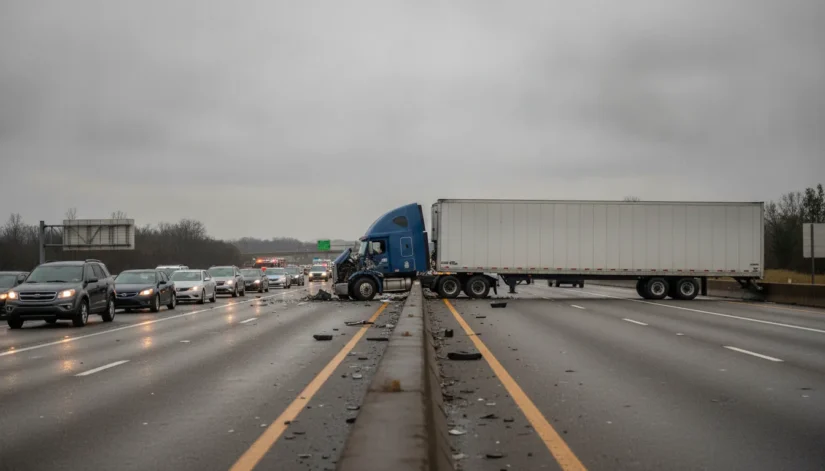
A Georgia 18 wheeler accident lawyer is usually asked one question first. Who, besides the driver, may be responsible? An 18-wheeler is a tractor and a trailer. The company on the door, the business that hired the truck, and the company that loaded it are not always the same. The useful work is matching the crash to the records those companies already keep.
Call (404) 835-4935 for a free case evaluation
Henningsen Injury Attorneys, P.C. represents people hurt in truck and other motor-vehicle crashes across Georgia. Managing partner Todd Henningsen leads the firm from offices in Atlanta, Cumming, and McDonough. The firm handles these cases on a contingency fee, which means attorney fees are paid from a recovery. This article explains the liability questions. It is general information, not a prediction of what any one claim will do.
Why an 18-wheeler crash is a company file
A passenger car crash often starts and ends with one driver. An 18-wheeler crash usually starts with a business. Someone dispatched the truck, set the delivery time, maintained the tractor, and decided what the trailer carried. Those choices can matter as much as the last few seconds before impact.
Georgia personal-injury claims for a crash generally have to be filed within two years after the right of action accrues, under O.C.G.A. 9-3-33. That deadline is not the only clock that matters. Electronic logs, dash-camera video, and inspection notes are overwritten on a much shorter cycle. Waiting until the lawsuit deadline to ask for them is often too late.
The Atlanta truck accident page is the place to start if you want the firm’s truck practice. This article stays on a narrower question. It covers who may be responsible in a Georgia 18-wheeler crash, and which records usually answer that question. It does not estimate what a claim is worth.
Who a Georgia 18 wheeler accident lawyer looks at first
The first name is the driver. The second is the motor carrier, the company that ran the truck. The third group is everyone else who controlled a piece of the trip. Georgia law lets a jury consider the fault of each person or company that contributed to the injury, including businesses that are not parties to the suit.
The practical split looks like this.
| Who may be involved | What the question usually is |
|---|---|
| The driver | Speed, following distance, fatigue, distraction, or a missed inspection. |
| The motor carrier | Whether the driver was doing the company’s work, and whether the company hired, trained, or dispatched an unfit driver or truck. |
| A tractor or trailer owner | Whether equipment it furnished was unsafe, and whether that condition played a role. |
| A shipper or loader | Whether the cargo was overweight or poorly secured, and whether that business controlled the loading. |
| A freight broker | Only a duty that business actually took on, such as selecting the carrier. Arranging the load is not enough by itself. |
A name on the trailer is a starting point. It is not a verdict. Some carriers lease both the tractor and the driver. The contract may call the driver an independent contractor while the carrier still sets the route and the delivery time. The question is who directed the work.
In Quynn v. Hulsey, the Supreme Court of Georgia rejected a shortcut carriers used to rely on. A jury may still weigh the company’s separate fault for hiring, training, supervision, or entrustment. That remains true after the company admits the driver was doing its work. Admitting the driver was on the job does not erase those other questions.
Hours, logs, and the truck the company sent out
Interstate carriers follow federal hours-of-service rules. Those rules do not replace Georgia negligence law. They show what the carrier was required to do before the crash.
The FMCSA hours-of-service summary sets the ordinary limits for property-carrying drivers. A driver may drive up to 11 hours after 10 consecutive hours off duty. The driver may not drive beyond the 14th hour after coming on duty. A 30-minute non-driving break is required after 8 cumulative hours of driving. The driver also may not drive after 60 hours on duty in 7 consecutive days, or 70 hours in 8 days, unless a qualifying restart applies.
An electronic log is the record that tests those limits. A company that assigns a run the log cannot legally support is making its own decision, not only the driver’s. A clean log does not end the inquiry either. A driver can be inside the hour limits and still be unfit for the trip because of a medical card, a prior violation, or a truck that failed inspection.
The equipment file sits next to the log. Brakes, tires, lights, and coupling gear have inspection and repair histories. If a part failed, the question is whether that failure was already in the file and the truck was sent out anyway. Common crash causes, including fatigue and poor maintenance, are covered in the firm’s note on common causes of truck accidents in Atlanta. The point here is the record that proves or rules out each cause.
Insurance minimums are not the same as coverage
People often hear that a truck “has a million dollars” of insurance. The federal minimum is more specific, and it is a floor, not a description of the policy on a particular truck.
Under 49 CFR 387.9, one row of the schedule covers for-hire carriers in interstate or foreign commerce. It applies when the vehicle has a gross vehicle weight rating of 10,001 pounds or more and the cargo is nonhazardous property. For that row, the public-liability floor is $750,000. Hazardous cargo can raise the floor to $1 million or $5 million, depending on the commodity. A private carrier hauling ordinary freight is not in that $750,000 row.
Two limits follow from that schedule.
- The minimum is not the policy limit. A carrier may buy more. The declarations page, not the regulation, shows what was actually in force.
- The minimum is not a measure of the injury. A serious crash can exceed the policy. What can be collected still depends on who is liable and what coverage applies to that defendant.
Georgia also limits when the insurer can be added as a defendant. Under current O.C.G.A. 40-1-112, joining the motor carrier and its insurer in the same case is allowed only in narrow situations. Those are when a related motor carrier is insolvent or bankrupt, or when personal service cannot, after reasonable diligence, be made on the driver or the motor carrier. The 2024 change applies to causes of action accruing on or after July 1, 2024. Outside those situations, the claim proceeds against the carrier and the driver. The insurer is not added at the start.
How shared fault changes a Georgia truck claim
Georgia reduces a recovery by the injured person’s share of fault. Under O.C.G.A. 51-12-33, if you are partly responsible, the court reduces the damages in proportion to that share. If you are 50 percent or more responsible, you recover nothing. The same statute is what lets a jury assign separate percentages to a driver, a carrier, and another company. Those shares are several. They are not one joint bill that any defendant can be forced to pay in full.
Company fault and driver fault are not the same percentage copied twice. A jury might find the driver primarily at fault for the driving and still assign the carrier a share for sending that driver out. Or it might find the carrier responsible only through the driver’s work.
That is also why a careful file looks at the injured person’s own driving before anyone talks about a number. A lane change, a following distance, or a missed signal can change the result even when the truck is the larger vehicle. Henningsen reviews the truck claim as part of a broader motor-vehicle practice that also includes car accidents. The truck case is different because the company, the equipment, and the federal file are usually in play.
What the scene tells you before the records arrive
The first hour after an 18-wheeler crash produces facts that later paperwork has to match. The position of the tractor, the trailer, and the other vehicles is one of them. So is the debris field, the skid or no-skid pattern, and whether the trailer is still coupled. Those details do not decide fault. They tell you which records to ask for first.
A jackknife, a rollover, and a rear-end impact point at different files. A jackknife often raises the load, the coupling gear, and the speed into the curve. A rollover can raise the same questions plus the trailer’s center of gravity. A rear-end impact by the truck raises hours, following distance, and whether the driver had room to stop a loaded combination. An impact by a car into the trailer raises a different question, including whether the trailer was where it should have been.
The door of the tractor and the side of the trailer should be photographed before the wrecker moves them. The USDOT number, any motor carrier number that is posted, and any lease placard are how a preservation letter finds the right company. A trailer with one name and a tractor with another is common. Treating them as one company loses the second file.
Witnesses matter for the same reason. A driver in the next lane can say whether the truck changed lanes, whether a signal was on, and whether the trailer swung wide. That account is fresher at the scene than it will be months later. Write down the name and a phone number. A later statement can be compared with the electronic log and the dispatch messages.
Medical care comes before any of that paperwork. Get treatment, and tell the provider how the crash happened. The legal file can wait a day. The log and the video often cannot. A short written request to preserve the electronic log, the dash camera, the pre-trip inspection, and the repair file should go out as soon as the company names are known.
What to preserve before the file is overwritten
A Georgia 18-wheeler claim is a records question before it is a courtroom question. The useful file is usually already in the carrier’s office. The work is getting it before it is overwritten, then reading it against the crash.
A careful review tends to move in this order.
- Photograph the tractor door, the DOT number, the trailer, and any lease placard. Those names are how the file is requested.
- Fix the driver’s status. Was this a company employee, a leased driver, or someone the carrier called a contractor?
- Compare the electronic log with the dispatch messages for the day of the crash.
- Check the license, the medical card, prior violations, and the last drug or alcohol test.
- Match the pre-trip inspection and recent repairs to any part that failed.
- Note the broker, the shipper, and the equipment owner, and what each one actually controlled.
If a crash kills someone, the family may have a separate wrongful death claim. That claim has its own rules about who may bring it and what it covers. It does not change the question of which company is responsible.
Henningsen Injury Attorneys reviews truck crashes from its Atlanta, Cumming, and McDonough offices and serves people hurt across Georgia. Todd Henningsen, the managing partner, is licensed in Georgia. A free case evaluation is a review of these facts. It is not a promise about the result, and it is not a case-value estimate.
Call (404) 835-4935 for a free consultation about a Georgia truck or 18-wheeler crash.
Frequently asked questions
Can the trucking company be responsible if the driver caused the crash?
Often, yes, if the driver was doing the company’s work. The company can also be responsible for its own choices, such as hiring, training, dispatch, or sending out a truck that should have stayed in the shop. Those are separate questions, and each one needs proof.
Does a federal hours violation prove the company was at fault?
No. A violation is evidence about what the rules required. It matters when it connects to how the crash happened. A log violation that has nothing to do with the collision is not, by itself, the cause of the injury.
Is the truck’s insurance always at least $750,000?
No. That figure is the federal public-liability floor for certain for-hire carriers hauling nonhazardous property in interstate or foreign commerce. Other cargo, private carriers, and the actual policy can sit at a different number. The policy, not the regulation, controls what was in force.
How long do I have to file in Georgia?
A personal-injury claim for the crash is generally two years under O.C.G.A. 9-3-33. Wrongful-death timing and claims involving a government vehicle can differ. The evidence clock is shorter than the filing clock, so the records request should not wait for the lawsuit deadline.